Mostrando entradas con la etiqueta English. Mostrar todas las entradas

viernes, 25 de febrero de 2011

Curriculum Vitae (English)


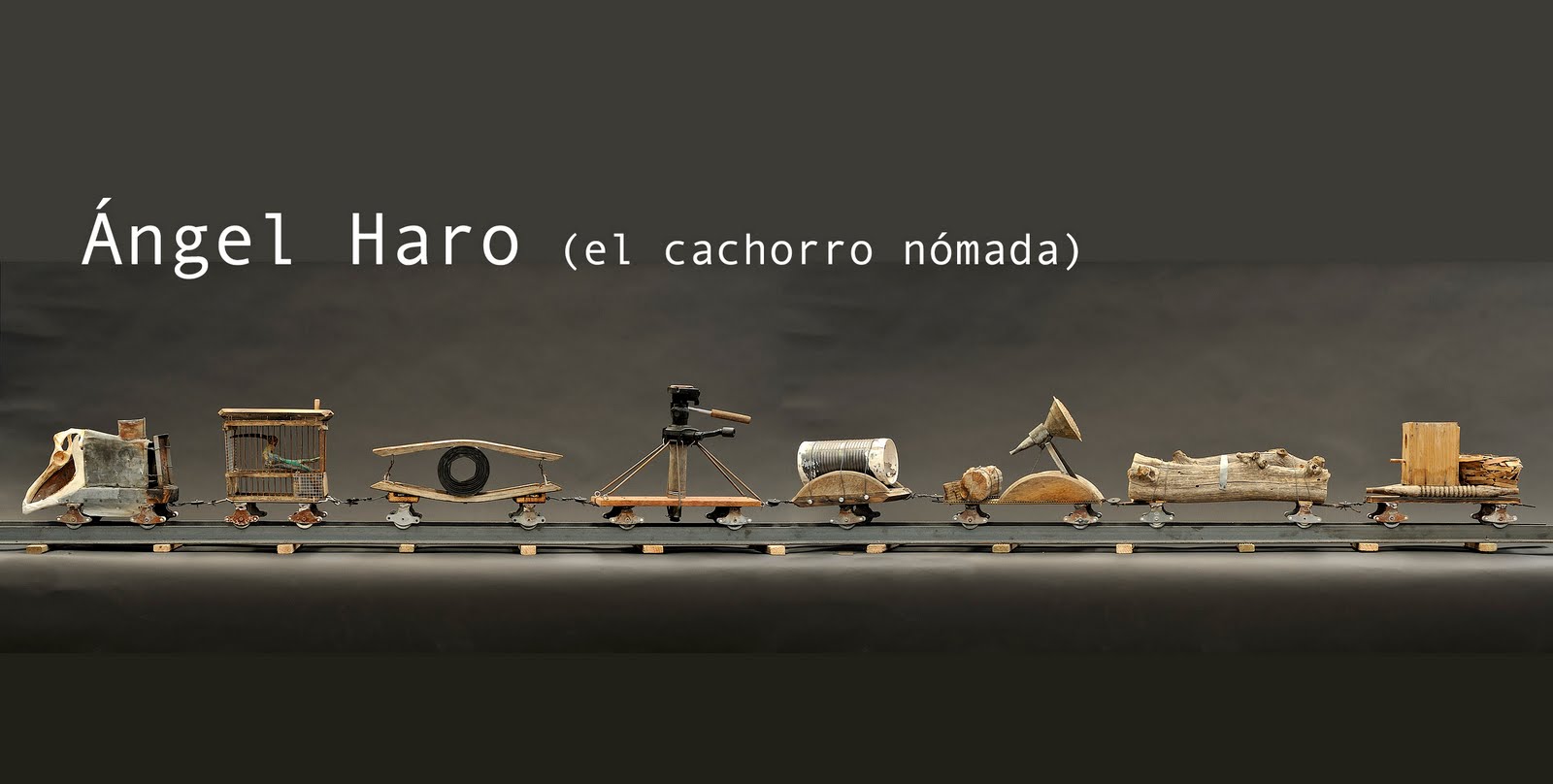
ANGEL  HARO 1958.   
He was born in Valencia (Spain) 
Expressiveness plastic artist and stage designer. He is carry on his work from 1979 as plastic artist  and, from 1991, as stage desiner in several productions of cinema, theatre and  opera.

INDIVIDUAL EXHIBITION

2014.  LA TREGUA. Tabacalera, Madrid
2013.  FOLITRAQUE. Pedro Cano Fundation. Blanca, Spain.
2012.  WAYS OF AN UNRULY MAN. RESOLUTION Gallery. Johannesburg, South Africa.  
 
2011.  ECO CYCLOPS. Mine Agrupa Vicenta. La Union, Spain
           MELANCOLIE SUITE. LINA DAVIDOV gallery. Paris.
2010.  INDICO. 23º 51' 24'' S / 35º 32' 52'' E. LA AURORA gallery. Murcia, Spain.
2010.  NCOMATI. BAMBARA gallery. Cartagena, Spain
2009.  BELFEGOR. MUSEUM OF FINES ARTS. Murcia, Spain.
           THE SHADOW IN THE MIRROR. LINA DAVIDOV gallery. Paris
2007.  WALKER. LA AURORA gallery. Murcia, Spain.
           WALKER. ZMB gallery Madrid.
           NKA gallery. Bruxelle.
2006.  BLACK DIAMOND. CAJAMURCIA cultural center. Cartagena, Spain.
2005.  INTERIOR SOUND. CAJAMURCIA foundation. Madrid.
           INTERIOR SOUND. LA AURORA gallery. Murcia, Spain.
2004.  ON PAPER. HAIM CHANIN FINES ARTS gallery. New York.
           KUR gallery. San Sebastián - Spain
           THE VOICE OF SUBMERGED. LA CAJA NEGRA gallery. Madrid.
           THE VOICE OF SUBMERGED. LA AURORA gallery. Murcia, Spain.
2003.  PRIVATE LANDSCAPE. NADIR gallery. Valencia-Spain.
           THE MUTINY OF DREAMS. Gallery BEGOÑA MALONE gallery. Madrid.
           BORRON 4 Gallery. Cambados, Spain.
2002.  PRIVATE LANDSCAPE. LA AURORA gallery. Murcia-Spain.
2001.  PRIVATE LANDSCAPE. ANTONIA PUYÓ gallery. Saragossa, Spain
2000.  FUTURE WAS YESTERDAY. Church of VERÓNICAS. Murcia, Spain
1999.  AMADOR DE LOS RIOS gallery. Madrid, Spain
           PAPER 999.  LA AURORA gallery. Murcia, Spain.
1998.  DEL PALAU gallery. Valencia, Spain
           VULCANO.  LA AURORA  gallery. Murcia, Spain
1997.  INTERIOR SONAMBULA. LA AURORA gallery. Murcia, Spain.
1995.  LA AURORA gallery. Murcia, Spain.
1994.  NOMAD THE PUPPY. University of Saragossa.
1993.  PUPPIES. Gallery PASAJES. Murcia, Spain.
1991.  MAMBO NORTE.  MURALLA BIZANTINA gallery. Cartagena, Spain
           ELADIO FERNÁNDEZ gallery. Madrid.
1990.  ISTITUTE OF HISPANIC CULTURE. Sto Domingo, Dominican republic.
1989.  ROBIN WATER. Church of SAN ESTEBAN. Murcia, Spain.
1987.  WHERE ARE NOT YOU SEE? gallery CLAVE gallery. Murcia, Spain.
1984.  MUST BE GOING THROUGH THE HARO. ZERO gallery. Murcia, Spain.
1983.  ZERO gallery. Murcia, Spain.
1979.  CAÑO gallery. Lorca, Spain.

COLLECTIVE EXHIBITION

2011.  ART CHICAGO 11. LA RIBERA gallery. Chicago.
           ART MADRID 11. LA AURORA gallery. Madrid.
2010.  ÍNDICO 23º 51' 24'' S / 35º 32' 52'' E.  LA AURORA gallery. Murcia, Spain.
           ART MADRID 10. LA AURORA gallery. Madrid.
2009.  ART MADRID 09. LA AURORA gallery. Madrid.
           DISASTERS. RESOLUTION Gallery. Johannesburg, Southafrica.
           SOUTH TO SOUTH.  FORTALEZA gallery. Maputo, Mozambique.
           VII FAIR CRITICISM. PARRAGA CENTER. Murcia, Spain.
2008.  ART PARIS 08. HAIM CHANIN gallery. Paris.
           ART MADRID 08. LA AURORA gallery. Madrid.
           66 pieces on the wall. HAIM CHANIN gallery. New York.           
           FACES. RESOLUTION gallery. Johannesburg, Southafrica.
           ARTENAVAS. Navas del Marques, Spain.
2007.  ART PARIS 07. HAIM CHANIN gallery. Paris.
           ART MADRID 07. LA AURORA gallery. Madrid.
2006.  I ONCE BIENNIAL FOUNDATION. CIRCLE OF FINE ARTS. Madrid.
           ART PARIS 06. HAIM CHANIN FINES ARTS gallery. Paris.
           ART MADRID 06. LA AURORA gallery. Madrid.
           GOYA. X. CULTURAL CENTER. Ceutí, Spain.
           THE DAYS OF JÁMILA. LA AURORA gallery. Murcia, Spain.
2005.  SPAIN REVISITED. HAIM CHANIN gallery. New York.
2004.  ARTMIAMI 04. LA AURORA gallery. Miami.
2003.  ARTMIAMI 03. LA AURORA gallery. Miami.
2002.  THE PAPER OF ART. ESPACIO LÍQUIDO gallery. Gijón, Spain.
           ARCO 02. ANTONIA PUYÓ gallery. Madrid.       
           MIART 02 Contemporary art fair. LA AURORA gallery. Milan.
           V BIENNIAL OF PAINTING. Museum of Albacete, Spain.
2001.  OWN & STRANGE. MARLBOROUGH gallery. Madrid.
1999.  PARRAGA TIME. DETRÁS DEL ROLLO gallery. Murcia, Spain.
           VI BIENNAL UNIÓN FENOSA. La Coruña, Spain.
1997.  PROPOSALS. CIRCLE OF FINE ARTS. Madrid.
           SIX ARTISTS FROM SPAIN.  PETER BARTLOW gallery. Chicago.
1995.  ARCO 95. CAZ gallery. Madrid.
           ACTUAL WORKSHOPS. CIRCLE OF FINE ARTS. Madrid.
1994.  XXI BANCAIXA PRIZE. Valencia, Spain. 
           BIENNIAL OF FINE ARTS. Almería, Spain.
           BIENNIAL OF SCULPTURE. Murcia-Spain.    
1993.  BIENNIAL OF PAINTING. Church of SAN ESTEBAN. Murcia, Spain.
1992.  CONTRAPARADA. MOLINOS DEL RÍO gallery. Murcia,Spain.
1991.  ACTUAL WORKSHOPS. CIRCLE OF FINE ARTS. Madrid.
1990.  25 YEARS OF CAJA MURCIA. ALMUDI PALACE. Murcia,Spain.
1988.  IMAGES OF THE VIDEO. AMADIS gallery. Madrid.
           IMAGES OF THE VIDEO. Council of Valladolid,Spain.  
           SIX CREATORS. SASTAGO PALACE. Saragossa, Spain.
           IMAGES OF THE VIDEO. Council of Madrid.
1987.  CONTRAPARADA 8. Church of SAN ESTEBAN. Murcia, Spain.
1986.  NEW YORK CON SUMA ART. SAN ESTEBAN gallery. Murcia, Spain.
           TWENTIETH CENTURY PAINTING. MUSEUM OF RIGA. Lithuania.
1985.  ARCO. ZERO gallery. Madrid.
           EUROPALIA. Antwerp, Belgium.
           ART IN MURCIA. MUSEUM OF THE CITY. Madrid.
1984.  10 SPANISH CONTEMPORARY PAINTERS. PASSARELLA gallery. Milán.
           10 SPANISH CONTEMPORARY PAINTERS, ISTITUTO ITALIANO D'ARTI GRAFICHE.   
           Bergamo,  Italy.
           10 SPANISH CONTEMPORARY PAINTERS. D'ARTI MODERNO Monza.
           ARCO 84. ZERO gallery. Madrid.
           MURCIA-PALMA. Gallery JOAQUÍN  MIR. Palma of Mallorca, Spain.
1983.  CONTEMPORARY SPANISH PAINTING. College of architects Murcia, Spain.
1982.  MURCIA TODAY. Council of Murcia, Spain.
1981.  CAÑO gallery. Lorca, Spain.

MUSEUMS AND COLLECTIONS

     Fundation DORSKY. New York.
     Fundation Cajamurcia.
     Museum of Contemporary Spanish Engravings. Marbella, Spain.
     Assembly of the Murcia region. Cartagena, Spain.
     Autonomous Community of Murcia, Spain.
     Art Museum in Tehran, Iran

AWARDS

2001.  Support for creation. Ministry of Culture. Spain.
           Support for creation. Foundation Art and Law of VEGAP.
1994.  Engraving Prize. Museum of Contemporary Engravings of Marbella.
           Biennial Prize for Sculpture. Autonomous Community of Murcia. Spain.
1987.  Prize video creation. Ministry of Culture. Spain.
           Support for creation. Autonomous Community of Murcia. Spain.
1986.  Bag stay in New York. Autonomous Community of Murcia. Spain.
1985.  Poster Award INTERMUNICIPAL CONFERENCE AGAINST SEGURA  
           RIVER POLLUTION. Assembly of the Murcia region. Spain.

STAGE DESING

2010.  HIMMELWEG.
Theater by Ferroviaria company.
2009.  POKER FLAMENCO. Dance by Matilde Rubio company.
           A CHRISTMAS CAROL. Theater by Ferroviaria company.
2007.  THE CAUCASIAN CHALK CIRCLE. Theater by Ferroviaria company.
           THE AVIATOR.
Theater by Ferroviaria company.
2006.  CARONTE. Opera by performing arts center SAROBE.
2005.  THE LITTLE GYPSY. 
Theater by Ferroviaria company.
2003.  THE IMAGINARY INVALID. Theater by Ferroviaria company
           THE USHER. Opera by performing arts center SAROBE.
           THE DEEDS OF POPE UBU. Theater by Ferroviaria company.
2001.  TUSITALA (Treasure Island ). Theater by Ferroviaria company.
1999.  THE HUMAN VOICE. Opera by Arena prd.
           BASTIAN AND BASTIANA. Opera by Murcia Cultural sa.
           HAMBLET.
Theater by Ferroviaria company.
1998.  1940. Dance by Ferroviaria company.
           ZAPPING. Feature film by Aurum sa.
A MIDSUMMER NIGHT’S DREAM. Theater by the High Dramatic School of Murcia.
1997.  GO FOR GOLD. Feature film by Win Wenders & Marea films.
           DON JUAN AND HIS SERVANT. Opera by Arena prd.
1996.  BLACK RIVER.  Dance produced by himself.
1995.  GYPSI SOUL. Feature film by Samarkanda sl.
           THE PRIVATE LIVE. Feature film by Buenaventura films.
1992.  HELL PROMISED. Feature film by Kinos Klan sa.
           PACO, MY FATHER. Feature film by Murcia Cultural. 
           TRIBUTE TO PACO RABAL. World Trade Center. island of Sevilla
           TRIBUTE TO PACO RABAL. Theatre Romea of Murcia. 
1991.  MUSHAFIR. Short film produced by Kinos Kla sa.

lunes, 6 de septiembre de 2010

The city like a museum (Jose Forjaz)

The integration of artistic skills is neither a discovery nor a form of production that is new artistic, erudite or creative.

The Metopes in the Parthenon pediment, the Chaldean enamelled brick walls, the parietal vibrations of Egyptian relief-work or the illustrative stories of the capitals of Vézelay, as likewise the wall rendering in the Taj Mahal or the solid block geometry of the Inca at Cuzco and Machu Pichu; all transcend the spatial scope of architecture, to be shown as aesthetic strata, as skins which characterise architectural existence.

The idea that architectural work can be an excuse or a platform of an expressive dimension, more rhetorical than literal, more commercial than picturesque, more popular than learned, and therefore more set in terms of generalised aesthetic mediocrity, was left behind in the maelstrom of fruitless searches of the final 20 or 30 years of the aesthetic prostitution which characterized the puerile adaptation of irresponsible and irrelevant adventurism of contemporary architecture.

In fact, it is surprising that so few attempts have been risked beyond the resolution of animated or illustrative surfaces which new technologies make possible, facilitate and suggest. These are still, and above all, architecture; and for that very reason, implicitly integrated and integrative with an expression of space, the latest construction science and the construction itself.

The bi- and tri-dimensional expressive contribution which the painter or sculptor can bring to spatial reality in the architectural sphere, requires of the architect an understanding, a humility and a vision extending beyond his formal purpose, which is only possible through a perfect empathy and sympathy of objectives in which the ultimate value of the aesthetic product is imposed on the self-promotion of an individual artist. Hence, surely, the rarity of the examples.

In the case in question, and analysing what Ángel Haro has confronted as a painter, is the urban dimension of a building, pictorially-supported on three facades; a two-dimensional volumetric which is subject to the movement and dynamics of the viewer and to a spatial distancing necessary for a complete reading and enjoyment of the artistic work.

In a simplistic and instantaneous reflection, this occurrence and this situation are dangerously parallel to the hoarding publicity of Coca Cola and Colonel Saunders, with whom he has to compete, so as to recover the dignity and potential of urban art in a visual world contaminated by the gross arrogance and lack of civic pride of the Consumer Society. This was without doubt one of the most difficult challenges that Ángel Haro has had; and has known how to resolve.

Without destroying or discounting the architectural volume, Ángel achieves a measure of chromatic density and of pictorial ambiguity which integrate, through random selection, the reflection of the sky and the presence of clouds, into a powerfully articulated geometry with all the control necessary for its technological dimension and for its urban setting. In this sense, the work surpasses the fresco and mosaic, and only appears possible in our technological and aesthetic era. Its contemporary nature is exactly what endows it with its greatest merit.

It is a work of perfect fusion between the spaciousness of the architecture and the bi-dimensional painting, each the reason for the existence of the other, yet impossible to live unsupported, mutually enriching and necessarily complementary.


Maputo. June 20, 2010

Machinery of shadows

To interact with the facade of a building is a challenge for any artist. The characteristics of the image and their interactions with material as capricious as glass, just as much as their relationship with the setting, convert it into a work that is both delicate and fascinating. There has to be present the responsibility which presupposes the influence of a work of this type on public space, since one treats the invasion the cityscape with the utmost responsibility. Obviously it is not until now that I see the finished work that I can more clearly assess the magnitude of the work and the courageous endeavour of everyone who has participated in it.

From my experience as theatre set designer, I have learnt to evaluate the sizing of an expression and its transference onto other materials as a double edged sword. Although it is certain that every artistic mark is enhanced with a certain naturalness as it grows, it is also true that its problems are made more evident; allowing the discovery of its defects which remain hidden when it is only a sketch.

My first concern was to create an image that would not lose vigour as it grew. It had to be taken into account that it was going to divide itself into three sides, which gave partial readings because from no one viewpoint could one see its totality, a limitation magnified when the very orientation of the facades subject the design to three different lights. The image, therefore, should have both an overall composition and a fragmented one which, at one and the same time, were autonomous. The colour also worried me since I was able to assemble a suitable range, but in dealing with a glass wall it was difficult to control that which was reflected. Hence from the first moment I opted for a pronounced chiaroscuro (contrasting dark and light) since I would prefer to leave the responsibility of the muting to the tones which the glass would absorb in a given situation. In this way the colour would have a character that was always natural. I wanted, at the same time, to introduce a dynamic effect to counteract the neutrality of the architecture.

The first sketches led me to watery forms with medium tints and sinuous patterns, but the very structure of the building rejected an interaction so vapid and I ran the risk of creating a very large “Chinoiserie” (1). I immediately opted for structural patterns which had sufficient presence to compete with an external visual impact of whatever type. Although it brought me closer to an interesting solution, I needed to try not to lapse into an excessively cold construction, nor to load my effort with a characteristically minimalist interpretation of volume. I needed a structure that would evoke a presence that was, at the same time, subtle. One of the things that stimulate me creatively when I travel to Africa are the precarious structures made of wood, iron and cloth. These structures of apparent fragility are a lesson in engineering (engineering of ingenuity) which nevertheless do not renounce at all the emotional charge through the physical. The fact that the geometry is arrived at without tools, almost freehand or manually, “warms” it in a form that makes it more human. Perhaps our technological tradition is very distant from the more humanistic usage of geometry in considering it as a tool and not as a transcendental objective.

After some weeks of exploring and discovering activity which traversed through some tri-dimensional pieces, I was ready to present an idea which substantially has been maintained until its completion: the image of machinery, or more precisely its shadow, acting as a metaphor of an organic and primitive movement which portrays the rigidity of the prism. Inevitably there came to mind during this process the great gestural works which, since “The Battle of San Romano” of Paolo Uccello up until the “Napoleon” of Abel Gance, have filled our visual art tradition. At times, I see this conjunction of ideas as the shadow of a battle in three linked photograms.

The drawing entered a technological processing which meant that it escaped from my personal control. This scarcely fitted the revisions made in accordance with decisions we took and which, nevertheless, had to be taken in the period in which the work as produced. To see the work amplified through more than five hundred pieces of glass has been one of the greatest emotions of my artistic career since, although I was able to recognize each zone, each fragment, they also appeared to me to be totally new. As they distanced themselves from me, they became for that reason, more interesting.

Looking now at the building in all of its grandeur and with my scale drawing in front of me, I remember how I constructed the earlier models, and my own size relative to them. To create this work was like the frivolity of a giant with a doll house. Now the work has become enormous, and the fidelity to the original has been such that I have become the diminished one, as was Gulliver when he woke up. At times, glanced at from the floor, I have strange sensation that my own drawing could become animated and emerge running with no further effort.

But at last the moment has arrived for allowing this image to integrate itself into the city, contaminating and being contaminated, exposed to the multiple sensibilities of the passers-by. The reasoning during the whole process was that I would not forget the most uplifting premise of this commission: to create something with the vocation of being a work of art in the public domain, but stemming from private property. I sincerely believe this harmony is the great virtue of this work of mine and that credit be given to all those who have participated in it.


December 2008


(1) The term “Chinoiserie” refers to the European artistic style which incorporates the Chinese influence and is characterised by the use of designs characteristic of that Asian country, asymmetry, capricious changes of size, the use of lacquered materials and of abundant decoration. Chinoserie entered Europe approximately in the last twenty five years of the 17th century and was at its peak in the middle of the 18th century when it was assimilated by the Rococo

miércoles, 1 de septiembre de 2010

The deep skin of paper (Francisco Carpio)

In the beginning was the print, that is to say, light and the heat of the body on a surface: the rocky wall of a cave. Later, the ephemeral linen cloth of the sand of the beach, the soft flesh of the clay or the red tattooed flesh of a face, a shoulder, a man, the dry epidermis of the parchment, the infinite plane-aleph of a sheet of paper… Marks, impromptus, registries of the man-man, the man-boy, the man-insane, of the man-artist, energy-stuck like a layer or an epiphany- to the surfaces of the creation.

However, time has passed and weighed upon us. Continual growth and the new technological tools are the protagonists, especially those of digital genealogy which have excessively illuminated on many occasions due to their complexity and sophistication, some distant and anonymous artistic products, some auras that are too cold, an almost total absence of colour and human warmth. The disappearance of that print, of that light. Thus, the físility, the manual temperature, the body of the material, seems to beat a retreat to its winter quarters (or its hell), from the electrical and virtual attacks of technology.

Let me remind you that even, at the beginning of the last century, André Breton asked the question. “Why have we to become slaves of our own hands?”, with which he apparently condemned to the exile from the Planet Art languages like drawing and painting..

Nevertheless, and in spite of continuous Death certificates made out by their everlasting (eternal)grave diggers, the truth of it is that drawing, as an expression of the immediate and the spontaneous, of gesture and of idea, and of painting is that pure and hard task of narrating, living and explaining to the world through the magical art of colour, of canvas and of paper. They are constantly reborn with new force, new ideas. We then discover that our hands need not turn to us their slaves, as Father Breton had feared. Hands think and can open doorways we have not dreamt we could cross.

I am sure that in such a chimerical and exciting company Angel Haro finds himself pawned. The search of that primeval print, of the physical and psychic presence of the hand, as an extension of the spirit, the vestige of the gesture as if it were a shadow cast over the battlefield of these paintings. An arena that our artist has consciously reduced to the skin of the paper.

Within the strict orthogonal limits of each picture many things happen. We cannot forget the area of the rectangle, it clears itself by simply multiplying its base by its height. But the area of these works, that is to say, the space of painted representation, requires much more complex formulae of composition and technique and much less foreseeable.

A strange balanced mixture (mix) of gestures, outlines, rectangles, scrapes, stains, rhythms, lines, crosses, trajectories, ovals, squares and circles make up its prosody. The cost of passion, of struggle and fire is cunningly compensated with the refreshing discipline of “Madame Geometry”.

Georges Braque once said “I love the norm that corrects the emotion”. Why don’t we complete it?: “The norm that corrects the emotion”, and “The emotion that corrects the norm. It is that dialogue, sometimes difficult, sometimes peaceful, sometimes a monologue which has been a constant that runs for years through the geography of its paintings. Thus, the structure converses with nervous and expressive gestures, the tectonic melts in the unformed, the dripping white blood inseminates the views, the straight line changes (transforms) into a curved line, the arabesque germinates into a checkerboard and reticule…..

Have they stopped to contemplate the ardent skin and the electricity of the light that covers these papers and almost physically illuminates them? We can feel its heat when we survey them with the yolks of our eyes, the tips our fingers. Erased light, veiled, blackened, watered down, semi-concealed, reticulated, soiled, hurt by architecture and the ironwork of the black pastel and oils, but it is light in the end and always will be. Square-windows, oval-viewpoints, rectangle-thresholds are ignited and are extinguished like an urban and nocturnal landscape.

At first, Colour has not been received too well in this fiesta of paint. The words of the night: grey, black, electric white, sepia …have talked over a long time. These are phrases of the dark, of twilight, of shades, of absence and forgetfulness but also of illumination, epiphany, blinding white, flashing albino. It seems that in his latest works Haro Angel it has opened the hunting season for colours, certain colours. The red ones, with almost all the shades, almost all the names: crimson, amaranth, ruby, purple, flesh, garnet, vermillion, scarlet, red, maroon, have taken possession of these new territories. And next to it, a warm cut of yellows, oranges and salmons giving heat and colour. Blood in the eye, blood in the picture, blood in the blood.

I know that Paul Valery considered drawing, poetry and mathematics as the three great human creations. This is odd, because I also see them in these paintings. I see the drawing, in the physical outline, in the handiwork of the concept, the importance of the material, the definitive role that the paper plays. I see poetry, in the modulation of the colour, the doors that are opened and they are closed, in the lyricism of the line and the stain. I see the mathematics in the rigor of the forms, the construction of the space, the binary code of the colours.

Furthermore, I see cities, I see marked interiors, I see wounds, I see melancholic funkiness, I see riotous dreams, I see the Sargasso Sea, I see sonorous forests, I see ballads, I see a world of spare parts, I see a field of stars, I see igneous and a great red-whiteness, I see a dream web, I see a rhapsody for a white angel-haro-. I see, I spy and what about you, what you see?


for the 2004 exhibition "On paper"

Black diamond (Terry W. O'Connor)

Without ever having set foot in Africa, the historic avant-garde saw the immediacy of the expressive potential of African masks and ancestral figurines. For me, a South African, Ángel Haro in a very brief visit there, goes beyond those images to perceive three important aspects of Africa. Firstly the rays of light which penetrate the cracks in the depressing tones with which the Dark Continent is typically presented. Secondly, he has detected the country’s life forces. He has also reawakened in this South African the realization that in Africa the extraordinary is ordinary.

1. In the “Black Diamond” series, those rays of light dapple the ever-moving sea of facial variations that Ángel has inversely modelled on ancestor and ritual masks. Those same rays dignify an Alexandra shack; giving a clairvoyance to looking outwards from the inside of one’s palace - one that is constructed more with pride than with materials. Those rays also distinguish the superficial from the essential in the Alexandra hospital, and they shatter European rumours that the South African cities, at night, are ghost towns. Thematically the Black Diamond always seeks, traps and shares its light. The metaphor of its transformation from carbon appears in the “Notes” series accompanied by Nelson Mandela, emblematic of South Africa’s own transformation. The juxtaposed “Diamond Ladies”, and the “African Art Museum", provoke questions about the superimposition of western order and symbolism on Africa. Capetown’s “Waterfront” also raises the question of the value in Africa, with its priorities so urgent, of yet another Western life force, hedonism.

2. Among Africa’s life forces are the elements from both east and west that for millennia have forcefully moulded the Cape of Storms and for 350 years shaped the culture of the Cape. Spain’s shrinking 17th century Catholic Empire had allowed Amsterdam to found present day New York, and just ten years later other Protestant Low Country settlers had successfully founded a town in the Cape of Good Hope and had introduced their Batavian slaves. The rhythm of that lifestyle was disturbed by the English who used anti-slavery as an excuse to expand their own 19th century empire. The resulting Boer emigration from the Cape collided with the Zulu expansion as would the English 40 years later. These works reflect the life forces of those legendary Zulus of Isandlwana, of Soweto´s “Hector Pieterson” almost one hundred years later, and of other unknown warriors; all of whom were to erode colonialism. Between the closing years of the 19th century and the early years of the 20th the two European colonising forces clashed and after two wars arrived at a peace. Democratic forces returned power to the Boers a further 40 years after that , just when the forces of Harold McMillan’s unstoppable “Winds of Change” began their 40 year southbound journey from Ghana. Both northwards and southwards forces carried with them the sad history of the oppressed becoming the oppressor. In South Africa it took the form of 40 years of apartheid, and still today Ángel’s “Africa Flight” crosses many other African countries whose political history is symbolised by the African mask’s pegged mouth. As a result many disenchanted people have fled from their liberators; often to Europe; ironically following the footsteps of their expelled erstwhile colonial oppressors.

3. In Africa the extraordinary becomes the ordinary. I can identify with the raw, and at times breathless expectation, of Angel´s concept of the hunter implanting himself within one´s eyes and of being the prey. Whether on foot or in car, whether accompanied or not, I have always found the elegant silence and solitude of “Kruger” and other game parks an awesome experience, with or without the reward of a “Big Five” sighting. In this context of animals in their own habitat, I conjure up a recollection of identifying the nearest climbable tree whilst engaging in mutual admiration with a rhinoceros. A feeling not dissimilar to that of Angel´s perplexed colt seeking an escape route. Another bridge for me between the ordinary and the extraordinary is “Indian Ocean at Night” conceived in Maputo Bay. It conveys to me the red rawness of Louis Trichardt’s trials and tribulations; of Cecil Rhodes’ burning ambitions; of the red light district role of Lourenço Marques (present day Maputo) during apartheid; of its flirtation with communism now discredited in Africa, and of the bloody civil war. These days the reddishness represents the spreading maturity of an uninterrupted economic recovery; and the vibrant, lighted and enlightened city on a bay that carries galleon histories and the wakes of the crafts traversing it.

These thoughts are not those of an art critic but those of one for whom Africa is in the blood. Space, the overlap of the extraordinary and the ordinary, and the vibrant intermix of cultures and personalities that constitute Africa, are all enriching experiences. Ángel has been able to express those enriching forces, not only visually, but also as he himself says “in a poetic way” in the commentaries that accompany the works. Working and living in South Africa and in seven of Africa’s central and southern countries for nearly 40 years, I realize that Africa has as many faces as a diamond and that the first experiences such as those of Ángel, grow with each further cultural variation and that all of these stimulate the visitor’s perspective of the extraordinary. In these works, I therefore appreciate the artistic perspectives and insights tracing the life forces that connect the intangible and the visible –the natural and the manmade; the present and the past and portraying them with a depth that demands concentration and reflection.


Interview for the 2001 exhibition "Black diamond"

martes, 31 de agosto de 2010

Private landscape (Mara Mira)

MEMENTO VIVERE

Angel Haro is an artist aware of the importance of the titles of his works and exhibitions. His studio walls are hang with sheets in which he writes possible paintings´ titles. He knows that with the words we can distinguish universality from particularity. A dichotomy in which philosophers from Platon are totally wrapped up in, and a fundamental issue in the Arts History since symbolists, late 19th century, demanded generalized practices out of their particular views of mankind. Besides, in the 20th century, titles can not be considered superfluous. After the success of Parisian halls, cataloguing was imposed and thus images became dependent on written words. Haro thinks that titles supply viewers with additional information so that they can understand mentally. Images´ sensoriness becomes trapped by the conventionality and language specifications. As an example, two years ago, in his exhibition entitled El futuro fue ayer (Future occurred yesterday) in Sala Verónicas in Murcia we were warned that the future is like a canyon blowing us while it moves backwards, towards the past. Its bullet, as any vector, should follow its direction. Our sense of time goes from left to right, exactly as our writing. The left side is the past while the right correspond to the future, which changes, nothing can stop it, it will always be in the bullet horizon. The past also moves: unnoticeably it goes further and further from us.

His new work is entitled Private Landscape. Haro knows that the cornerstone where modern nostalgia is built on requires images from the nature. It seems to represent what humankind could have been if we hadn’t lost the course of the future. That straight line in which very few believe in. A landscape and a nature he has pointed out:

The landscape seen by the nomad (the artist) is a hunting field. Since his first glance, he has to assume his survival. Firstly he examines its structure, the main elements articulating its order, then its arrangement, and exploration possibilities. His senses strained as a bow are ready to perceive any movement or change (light, color, heat, smell, etc...). It´s a landscape lacking myths because memory is needed for their existence. It’s a landscape of instincts.

Thus, the landscape is a hunting ground in which Haro recognizes himself part of a collective. Collective are attached to the past, but a single person lets himself rocked by the nostalgia of memories, of the privacy. There is nothing new. Many artists are solitary persons who repeat: this will die. They work with the vague, deep, and calmed sadness of melancholy. An emotion capable to cover everything.

Memory is an inevitable sentiment. Nostalgia is the distrust in the future but melancholy is purer because it doesn’t refer to any specific image. It’s the only sentiment that misses the present time (...)The melancholy that arises from some works comes from the exercising of activating disillusions. One starts with a splendid concept of life and ends resigning oneself to a little of silence in order to listen to oneself.

When Haro writes it he is aware of the genuine solitude, the doubt against the newness, and without any ideological prejudice. A solitary person recognises himself misfit. He teams up with anybody. He only follows his heart. Perhaps the above items may suggest a poetical vision of life, on the contrary, it´s something physical. John Cage relates that when he was invited to enter in a soundproof chamber in Harvard University, he heard two pitches of a sound: low and high. The engineer in charge of the chamber told him that the absolute silence is impossible. The low sound corresponded to his nervous system while the high sound to his blood circulation. It´s not possible to escape from our own body´s fluids. We do not only listen to our interior but also to sounds reflected from our own voices that the space returns to us: confronting the echo we feel naked. And in front of his look´s echo is where Haro is standing in his landscape.

He works on a big wooden pannel in his studio. This vertical support is over two metres and was built in October, 1999. It has been collecting the marks of his creative work. The wood keeps past stains, irreversible marks layered conforming a cartography of the ephemeral past. Photos of the pannel have been taken and the negatives developed on acetate. They are not ordinary photolytes because they have been stamped with a printing machine 1.20 x 1.60 metres in size. The technology Haro uses is accomplishing its last works. When Haro starts this series he kows that this machine will stop working some months later, December 2001.

Now, these photolytes in which his drawing board appears are placed on the pannel, exactly in the same place previously occupied by the papers that left their footprints. Haro paints on his own babblings, on the spot that trespassed the boundary, on the unconscious part of the creative fact. Then he closes his painting in a box. Its methacrylic surface reflexes what is in front. It is necessary to approach to see the painting well. When the series is over he will left the printing house.


MUSIC

In order to work, The music isolates himself from the world. Sounds promote his creativity. We could say that an authentic synesthesia occurs between his painting and the music he listens to, mainly jazz. But the artist is conscious that none of our senses represents a domain of homogeneous perception. The concept of synesthesia (sensation produced in one modality when a stimulus is applied to another modality, as when the hearing of a certain sound induces the visualization of a certain color) is, in many cases, a false work argument. Nevertheless, he thinks that painting as well as music have their own tonality: from high to low, from strong to soft; it can be lyric or dramatic. Haro, as Rousseau, considers that colors are in the space while sounds are in the time to vanish. His relationship with the music is physical. He dances in front of his composition in a consciousness state rather automatic, letting himself be carried. He understands that music unchains trans-sensorial perceptions which do not belong to any particular sense, but a sense can be contaminated by another sense, without being trapped by the boundaries of that sense. He knows, for example, that rhythm is everywhere around us. It´s a basic trans-sensorial dimension we even perceive before being born when we listern to our mother´s heart. In addition, texture is one category of this perception because it is the most tangible quality of objects, before their color or shape. Texture is the core of things, hence his admiration for Miles Davis, fascinating musician of trumpet´s limpid, sober, graceful expression. Haro usually says:

Nobody before him has expressed the human being solitude. The painter meets himself in the trumpeter´s sonorous permutations. In this whirling entropy in which order–disorder happen, slow-fast movements, either conscious or chancy, are linked. Moments in which shapes, however, tend towards a structure that can acquire a non-definitive meaning, non-fossilized, alive as an organism shouting. For Haro, music is the symbol of a perception passing through our senses, likewise, going beyond its frame and giving the impression of continuity somewhere. Many sonorous occurrences are chained, masked, or superimposed in time and space, in such a way that it is difficult to split them in order to study each part separately . This tangle of sensations is what Haro searches for in his paintings: the consciousness, subsequently, of the occurrence we see all of a sudden.

I have noted down the link of music with Angel Haro´s work due to his conception of art as a temporal process. His paintings shows the marks of his creation process, his genesis. Now we know how?, but what happens in the pannel?.


TIME

The 2 x 2.5 metre wooden plain is his Private Landscape. A landscape the artist fells ready to disappear. To preserve it, with complete verisimilitude, the artist orders to fotograph. It is interesting that this step is accomplished by a professional. He pretends to register the reality objectively. The artist seeks an extreme accuracy in these images since photos do not only fix our mementos but also our against-mementos activating forgetfulness. Images developed in photolytes, that is why they will be black, gray, and transparent. And on these, his painting as interference.

If there is a texture to define the XX century it is that of interference. Everything is interferenced: landscape, love, journeys,, dreams, time,...There is always an element that should not form part but becomes part of the new nature. An oil spot in the sea. An electric post in the forest. The past in a love. An accident in a journey. We evolve into interferences of our own dreams and these in interferences in turn of our life.

After reading the above artist´s statement written in his diary, It is no surprising to understand how he has reached the transgression process in his last production: the photo changes into a photolyte is the painting support. The interference of a support, of the means, of a time. The painter entrusts to cut the time in segments of present to a photographer, to shoot the clock as a Parisian in the French Revolution. The photographer confirms that the present is no more than an evanescent instant and insists in trapping a moment that, at the moment of being materialized, has become another present. Entrusting the photos to somebody else, the painter lets the photographer stop that instant turning it in the corpse of the eternity: when nothing happens; when everything is postponed indefinitely; when time changes into time. There, where the pure repetition is glimpsed; where everything has been postponed, emptied of any content. A record player repeating once and again the same melody.

In the filmed image of the pannel, reality becomes trapped as a precept. Nevertheless, forcing even more the sensation of loss, Haro films posteriously the photographer´s images with a printing machine, that is going to stop working soon. Now, I doesn´t work. It has been withdrawn from the world, devoured by the latest technology. Thus, the painter emphasizes our belief that modernity is a complex interaction between progress and nostalgia. Somebody would refer to this as melancholy amazement but also reactionary melancholy. It emerges as a consequence of affective conflicts. Laying away any stuff used that, being useful, should be replaced by the latest. Haro reveals against such imposition. He decides to preserve memory.

MEMORY

It is known that memory, a psychic power to keep and remember past events, is connected with the central nervous system because it organizes the necessary mechanisms to elaborate information in sequential steps. In the first step, the sensory perception should be coded to be transmitted. The third step, comprising association and abstraction, functions as a cocktail shaker mixing previously stored information and patterns that should lead us to the synthesis, the final mixture. Next, the storing process, as a drawer we open to evoke, either, positively, in order to remember, or, negatively, to forget. Any reminiscence is settled on the ruin of what it previously was. On the construction of the past. Memory settles on what has been written, on what has been built by our mind associating and abstracting data to rewrite them: a passage in which words are added constantly. A field plenty of spider´s webs that, with their fine textures, are composed of a light layer of superpositions in which there is always place for one more. If a filament breaks down, it can attach to another web. Anyway, though it breaks down it could be supported by the others. Memory is resolute when the spider´s web is steady and tight, however, it is also obscure and resolved when it becomes a mess, a greyish ball. Some events are remembered perfectly while others come fragmented: a puzzle missing pieces.

We have reported that memory opens spaces. It´s an odd puzzle that stores vague and clear information. A palimpsest continuously increasing. Memory is stuck by remembrances that can be activated unexpectedly as sleepers who wake up because of any past mark. A smell, a word, a sound, a color,.....anything can be a mark, everything provoking an emotional revivement. Out of all remembrances, those in which the man revives past events through dreams or deliria are the firmest; since logic does not take part those past events are placed in the present. The human being experiments them with the same strength. Besides, It is known that whoever finds difficult to sleep it is also lossing memory. To be awaken to forget eveything. Have you ever suffer from insomnia?. It leads you to think, to remember what scapes. One strikes on one idea and repeats and repeats it going down without end. The Insomniac muzzles his body to the present.

To establish our memories we should dream and get into a shade world in which future frees from past and past from future. A junction where everything is possible. Images can be so clear as reality but also vague and nebulous. The only state in which we can see a single image or more because any logic possibilitiy of time is fractured. The images Angel Haro presents in Private Landscape are install in our memory opening and closure. The have been oddly placed in that understanding junction that aproaches dreams.

Haro works on a material condenned to disapear, in a space that he will abandon. He works in the time against the time. He´s like a insomniac remembering what he knows will be forgotten. To achieve his task, he manipulates an etherial material that, in some ways, evokes the dreams´ world. He has changed the paper´s white surface, confronted everyday, by the image of that creation wall which has become his painting´s support. It could be in honor, a farewell too, of the space that has embraced him so long; in fact it´s just a continuation of his work. Haro has been noting in series of notebooks -fragments quoted have been extracted from. Within them Haro writes, sticks, keeps images, passages...with the purpose of remembering what he wants to remember.

There is a perverse pleasure in expoliating images turning their shapes, lights, and shades to the material world. Substracting these images leaving them without their history in order to check their real evocation power. I like then appreciate their brights, fissures, the density of their spectrum.

In his notebooks, drawings, notes, collages, thoughts, quotations and bits from newspapers. This reporting on the present would be the final work for many artists, for Haro it is only a part of his task. The first time you see these notebooks you feel you are in front of a color explosion but this impression vanishes when going deeper. Actually, they are obscure with a conceptual density that will be exalted in the later painting. Such greydish feeling increases when we notice the enormous quantity of press clippings: writers´ opinions, interviews, scientific articles,...nothing scapes from his curiosity. He thinks that any newspaper can be poetic material: the only fact is that it is not properly ordered¡, the painter states. This task of collecting the present and the reality leads him to the pannel he paints on.


PICTURE

On the photolytes´ shades world, Haro deposites the fluid movement of painting. Now his calligraphy and gesture are shown as a writer of ineffableness suggesting that a passage advances due to whatever is on its back. Thus, writing, scratching the surface, the painter defines himself physically. From the woof, lines, he ruins the belief that the image prevails against the substance. Against the formal contundence of the photolyte he superimposes the geometry of what is alive, determined with softened and velvety lines. Lines that seem to be bathed by light and vapour (a line that dreams, as Paul klee would say).

Here we can follow the trail of Haro by the Piranesi´s imaginative architecture. Haro is captivated by Pinaresi´s chimeric architecture, fantasies evoking and experimental past, a non-existence antiquity age. Piranesi wonders about the
project possibility, his projections are not attached to specific results. His works are open to debates. This arquitecture can not be assumed by a real praxis so that it should be confronted and understood from the imagination, utopia, drawing, shapes, lights and shades. For Piranesi, the old shapes are not a testimony of another time, their knowledge helps as a reference to supervise the present. He announces that the ruin is a success that necessarity we have to refer to.

He fells fascinated by his Carceri´s penumbra and brightness. Since he searches for a certain formal indefinition in his structures, he wraps the architectual elements leaving the botton in a complete ambiguity. The artist´s gesture muddles the line till it losses its sense becaming an space. The spider´s web over the spider´s web extending in a space far from what is the visible. The space as an experience. That´s is why we should not be surprised that on his pannel Haro writes in capital letters the name of the Russian Dimitry Kolésnikov, author of the note I m writing in darkness. Also, some of his works are dedicated to the Russian astronaut Gagarin. From the sky to the bottom of the sea where the nuclear submarine was engulfed. Perhaps, has the utopia run aground?.

On the photo, Haro explores the sense of the painting. Not only the lines but also the colors which get expanded, the wave reflected on the surface. The painter smears the photolyte with the color. Big spots of a single tonality trapping the diffuseness of Grey shapes at the back, fossilizing the universe of shades that would be hidden in the films. In the front part we are forced to see the material´s roughness and sensuality. The credible eventuality, the artist´s adherence to the ethereal photolyte. Certain areas are totally covered with scratched painting using a building palette; others he sticks yellowish nappies with a fine texture of spots. In both cases, they seem to be uncovered injuries . Intense and rational areas in color that structure the composition turning it squared. Such color spots directs the spectator´s vision towards a specific point, in which the artist´s physical action develops and the graphic event gives birth, denouncing an art in which the body is engaged and the present time vibrates.


TRANSPARENCY

We started analyzing the pictures´ background following the logic they have been conceived with. From the bottom onwards. One action after another in front of the spectator. However, to puzzle them out, the opposite process should be accomplished. From outside inwards. As archaeologists uncovering layer after layer. Time after time. Firstly, we see reflecting surfaces, methacrylic mirroring what they see: the exposure space and we approaching that space window. In order to see the painter’s creation we shouldn’t look at our opaque bodies, rather strip of our obvious and disturbed present. Introspection is necessary, abandon our present in order to achieve his. The reflection intervenes between the painting and us. Haro aims to entrust us with his painting’s secret, hidden from ordinary life flow the surface screens. As a lover crouched by a fountain cooing telling another his/her love without being heard by surrounding intruders. We should cross the mirror to get into Haro´s dreams. Only in a dream we can meet madness and paranoia. Also in a dream, our self appears plenty of experience. A dream always belongs to someone. It starts from the experience to escape from the logic. Logic paralyses the kingdom of creative thought, tyrannizing, and imprisoning it.

I have decided to create myself an autonomous thought fed by the common sense and utopia. In such junction, I believe that a territory worth being lived through and remembered without being ashamed can exist. Fortunately, my work allows me to build an internal structure. My painting’s usefulness is the construction of a landscape speaking clearly about me, with a spider’s web preciseness in permanent mutation.

These are the painter’s words who knows that logic is only a branch of consciousness, that can be encouraged through method, game as well. Artificial intelligence only possesses logic. But I doesn’t go beyond because, sometimes, logic does not support logic, neither the world. Somewhere emotions should be located, intuition without any boundary. Somewhere painting should be. To find it, the spectator will better abandon his/her blurred glance, stand up and look beyond its reflection to enter in the work space. He should overstep the continuum of the reflection to touch the discontinuum of the time. Unmask the present to look at the picture.


Interview for the 2001 exhibition "El paisaje privado"

Interview (Ache G. Louis)

My appointment with Angel Haro happens in an unpleasant afternoon at the end of the autumn. Squalls raise skirts and plastics resembling jellyfishes. The sky is quite blue and a lukewarm and mentholated wind turns Madrid into a rattlesnake sloughing off its skin. After coming into the cafeteria, everything is calmer. Without spending much time, I can see Angel through the pane of glass, he is trying to get something out of his eyes, something probably swept away by the wind.

A.H.-What a windy afternoon! Have you been longer waiting for me?

A.G.L.-No, just a few minutes.

A.H.-I like these windy afternoons, It’s like a premonition or rather a warning of nature.

We have just sat down and ordered some brandy when he asked me whether I’ve been to Museo del Prado.

A.G.L.-Whenever I come to Madrid I try to visit it. I went there yesterday afternoon.

A.H.-What did you see?

A.G.L.-Velázquez, Rubens (his carnality kills me). I also watched The Delightful Garden. What a feeling of disappointment restorations provoke!

A.H.-However, (theoretically) that’s how El Bosco painted it.

A.G.L.-Yes, but when we are accustomed to one picture, it’s difficult to see it different without being jolted.

A.H.-When we face a restoration, we notice that what really captivates us is the effect of time on the picture more than its characteristics, as if the only value of art were that of activating our nostalgia. Generally speaking, emotions bound to memory and history are overvalued. So far as I’m concerned, however, this picture’s X-ray fascinated me. It was literally like watching the image’s bones. Likewise, it could be appreciated the stretcher as well as its adjustments, the X-ray monochrome made it purer. I assure you that in front of that radiography I felt the emotion this picture had been painted with. I’m sure that El Bosco would be pleased to see it.

A.G.L.-You have just referred to a subject I find interesting to start our talk: memory and history. How do you face both so present at the moment in art and politics mainly in Europe?

A.H.-Personally I feel saturated. I think history is being used as a justification tool of extermination. I mean cultural extermination. When nationalists and patriots use the historic memory as an argument, they do not only idealize it but also advice against the contamination of unavoidable changes entailed in the development of any culture. What they wish is that independently-born culture becomes blocked forming then part of the utopian scenery. Any attempt on reviewing that memory is aborted, what has become institutionalized. On the other hand, I don’t agree with the statement the man who doesn´t know his history is doomed to repeat it......Instead., noting where some conflicts start nowadays, better ....the man who does know his history is also doomed to repeat it. I think that it is more and more difficult to situate the works of art geographically.......

A.G.L.-However, art has been a witness so that certain symbols could survive to time or, at least, it has been like that up to both the conceptual art and that so-called political art when art takes a different turn and the artist gets involved in public life.

A.H.- Apart from other facts, the conceptual art liberated the artist from the market, though this failed clearly, and art has become one more product. I don´t know whether it is right or wrong, but that´s the way it is. It happened to the political art as well. Furthermore, I think that certain pieces of art function like vaccines immunizing us against pain. Anyway, wherever the origin of a work, what interests me is its excitement capacity over its obviousness or simplicity. I don´t like ingenuousness in art.

A.G.L.- Some artists see an anachronism in the traditional supports, which displays interest as an archaeology. I mainly notice it in Spain. Even a work is called decorative derogatorily. I don´t know whether it worries you.

A.H.- I don´t bother the word anachronistic. Even more, I think that art is an anachronistic attitude. I doesn´t have to do with a race, and, anyway, such a race can only be against oneself. What is the use of one support or another if there is nothing to express?. Besides, I’m interested in technology. It would be stupid to refuse something happening around us and I think this is here to be used whenever needed. As an artist I don’t have an interest in becoming a member of the new technology-slave group that comprises the Western middle class. Nowadays, the cellular phone, the portable computer, the car, and the whole catalog of small desktop robots are the identity signs of a new slavers caste. If I were extremely rich, I will throw all stuff away or give it to someone working for me. On the other hand, art exerts a limited influence on life. The argument “there is no enough repercussion on society because the traditional supports are obsolete” seems an ingenuousity.

A.G.L.- Nevertheless, there are activities known as creative out of the Art institution which affect our behavior.

A.H.- You’re right. That’s why it is funny to see that when the communication strategy fails, we invent something called “new territories”, without accepting that what we are really doing is to unite, for the Art institution, activities that have been working for a long time and with much more clear purposes too. Let it be clear that the contamination is essential, but we should be coherent assuming the risks from inside and not sheltered behind “Mother Art”. I´d like to listen to expressions such as Now I´m going to publish my works in porno magazines or no more cybachrom in the art fair stalls,...”. That would be much honest. In other words, many of these artists try to poeticize their discourse by means of the perverse mechanism of replacing the ordinary circuits (mass media, shop windows, etc.,...) by the sacred room of the art grounds, i.e. galleries, fairs, and museums. There are artists who would never assume that their happenings are pieces of contemporary dance unsuitable for a theatrical circuit, or whose scenographies are perfect stage designs for a fair. My question is: would these artists show their works is such circuits without the label: this is art?. It’s ironical that a century after Duchamp´s ready made, what worries us is which object is worthy of the appreciation that the name Art entails, and for that, the iconography of the pain is used in many cases. Well, it’s also true that tragedy is within the raw material of the creation. Anyway, I think that the art crisis has to do mainly with its exhibition rather than its content. Too much attention focuses on the general public.

A.G.L.- With regard to the tragedy and except political issues: in your opinion, how is art going to react after S 11 in New York?

A.H.- We have attended a sort of live virginity loss which is affecting everybody and so artists as well. I don’t know what’s going to happen but I will be disappointed of any obvious reaction. We, artists who do not work with images from a reality are accused of escapism. I personally know what I feel as a citizen but nobody can oblige me to express my feelings of helplessness, perplexity or fury. At any rate, it’s difficult to compete in terms of impact with the reality and its spreading through the mass media. Buñuel said that it was an stupidity to provoke after Hiroshima bomb. Now, his statement possesses a special validity. I think that efficacy is like a virtue activated with a temporizer and thus I reserve my right to say what?, how?, where?, and when I want?. The problem is in the constraints. Few people is able to restrain themselves. We need to show everything we know and what we don’t know but overall we are unable to avoid communication, I think we should restrain ourselves in the use of materials, production, discourse, and communication. There is a moment when John Cage decides to stop composing till, in his own words, I found a better reason to compose than that of communication. We say we don’t communicate each other but I think there is an excess of communication. Perhaps its deficit doesn’t lie on the quantity but in the generosity to express our wishes and emotions. On the other hand, it is the high artistic pollution originated in Western countries what saturates the artistic production without paying attention to its consequences. There should be containers in the cities for recycling art materials.

A.G.L.- In any case, the communication factor adds an item appreciated by certain audience that the critics, so-called literary, support with theoretical arguments consecrated by the mass-media, thus, closing a circle that shows a new taste, from a supposed poetic objectivity.

A.H. –We have come to a point in which communication fills completely coexistence, it is also another artificial attitude because communicating means channeling and in this process it is inevitable to castrate impulses. Expressing is much natural. If you don’t intend to communicate, there is no place for regret; then, your work is not useful and thus nothing presses you while you’re going on your work. The vehement character of expression makes it more imperfect, less mass-produced, more amazing, and, consequently, more necessary. Its arrogant to believe that we are entirely the authors of the impulse that arrives to our work receiver.

A.G.L.- In spite of what you say, I notice a deep political concern looking at your notebooks that, though they contain sketches, present more and more political contents which are far away from your public production.....

A.H.- Sense of shame, contention, and violence are fundamental for me. Sense of shame to explode integrity, contention to be cured of obviousness, and violence to construct. In my opinion this position is political enough. When, for example, I paint a red oil painting on a red plastic, I think my discourse is quite clear. This is what really worries me. Gombrich stated: If art teaches us to pay attention to new visual combinations which are around, then art teaches us to watch....and for me that is a political vision. Personally I think that self-compassion only leads us to a disgraceful exhibitionism, to an elite pessimism which in turn results in interesting pieces of art –I hate this term used within the creation field. In my notebooks I’m rather automatic, that’s how these images are drawn. However, these aren’t sketches, at least, formally. Rather, buds of attitudes that will build their corresponding work. Looking at my notebooks, I was told that it seemed a contradiction to make political art in that private space. Nevertheless, I donut see those sketches in my works, I couldn’t stand such obvieties in my pictures, perhaps they fit better in a book, I’m not sure. As far as I’m concerned, debates on figurative-abstract or object art-conceptual-art belong to market affairs. How is that in the USA?

A.G.L.-In Europe, a great deal of such debate mainly focuses on the conquest of a fragile market. It ´s different in the States since the American Art concept is being reviewed. Exhibitions as that in the Withney Museum, you know, are shaking up a field with an enormous European background though the American market let the coexistence of different artistic trends. Now, with the incorporation of new historical references, the horizon is more complex and we’ll have to wait and see how the artistic community behaves. I agree with you that memory and history are overvalued because both are usually used as an alibi for speculative, economic, and conceptual transactions that justify almost everything. I think that such perversion is shared by both cultures and is even extending since it is effective for any power structure. By the way, I´d like to talk about something I perceive in your work and that I feel you worry at demonstrating. I mean a certain vital nomadism, a stateless position. I’m not sure if I’m going this too far.

A.H.- ...You’re touching on a vital subject for me. I still keep a fresh image in my memory that helps me to understand an stateless feeling I find difficult to escape from. I was five or six years old and lived with my family in an old timber building in a suburb in Paris. We were low-income immigrants and the only Spaniards in that block. I liked to spend the afternoons with an Algerian boxer who lived next to our room. His room was covered with other boxers´ photos and pin ups, and there always were four or five compatriots who used to visit him. Everybody spoke Arabic sat on the floor, smoking, having tea, laughing, arguing, and I used to spend the time rocked by that strange language I never could decipher and surrounded by that so alien atmosphere. I however felt so comfortable that sometimes I fell asleep and then this guy took me to my mother’s arms. I never knew what I particularly liked of that atmosphere but I realize I find outside places enormously attractive. I know it’s not a patriotic feeling but I get especially annoyed when I am too much linked to a group. I get the jitters when more than three persons say exactly the same with equal intensity. I have the sensation that it is dangerous or it’s a lie. Probably, it has to do with my denial to become accustomed to things and miss the astonishment that impregnates childhood, as Miguel Espinosa pointed out.

A.G.L.- That could explain your mobility though I think you’re very marked by some visual structures which give coherence to your work. Your transitions can be clearly noticed, overall, assessing the book you have just published.

A.H.- I’m not an artist of style. Perhaps, that is an impossibility. I’m deeply infidel to myself and my findings because I get bored quickly so that I have to shift. I used to have a dispersion complex that doesn’t bother me at all now. After all, we don’t behave in the same way so we have to accept how we are. After my book, which is a review of eighteen years, I observed, whether I like it or not, that I’m more coherent than I thought. Things are how they are and we can not be pending of making an interesting piece of art...

A.G.L.- In your last work, there is a formal process that turns your vehement vocation substantially cool and has, from my point of view, enriched your ways of expression without losing strength throughout your trajectory. I see that the combination of photolytes and brushed oils creates a trans-artificial atmosphere, as if you had decided to integrate within the nature context a steady tolerance towards previously unacceptable expressions.

A.H.- My arrival to these materials results, on the one hand, from the desire to remark the components involved in the process. These plastics used in printing to sensitize the offset sheets are so beautiful which have impacted me much more than any printed paper so that I wanted to bring them to light, dignify their texture. I wanted them to coexist equally with such a noble substance as the oil painting unstrongly applied, aiming at a more armonic interrogation. On the other, It was the fascination of the landscape which has been introducing bit by bit on my drawing desk. When I was thinking over working on it, one of the nearest piece I feel, I found the difficulty to repeat it. Furthermore, models and sketches were not quite helpful. Thus, I finally photographed and filmed that image in high-size photolytes. Then I came across one of the highest conflict: picture depending on the image. It was a tempting challenge to reverse the process: create an evocative atmosphere using, as basic material, an image deprived of any information and also serving as a support of a visual stimulus without allowing any narration ......I like the result!

A.G.L.- Besides, there is one element that provokes an active attitude and certain violence in the spectator, I mean the brightness and its difficulty. I´d like to know how do you assume such a risk as I notice you defend it as a part of your work.

A.H.- There is always something aggressive in the fact of being reflected in one work, as if trying to deviate our mind to another field we couln´t manage to avoid ourselves. At the beginning I doubted about it but I realized I was dishonest because that was the nature of the material, and if I were using it I had to assume its character. Later on, I got into the habit of my reflection and next I learnt to contemplate my picture without noticing my presence, in the same way we observe a landscape without perceiving an electricity pole in front of us. Perception is a subjective attitude. On the other hand, it was the first time I passed from a work of concave into a convex atmosphere one and I didn’t want to deprive myself of that adventure.

A.G.L.- There is however a clear tension we could call beauty though this is a voluptuous term. Your pictures´ atmosphere is indebted of romanticism that leads them to the anachronism we are talking about. I think they are very noble works from a human point of view. They are experiences instead of spaces.

A.H.- I like you talking about beauty which is a dreadful and mutable word scarcely used constructively. The metamorphosis such term implies occurs when the distance between observed object and observer changes. From a distance, pictures always show such a stupid cleanliness that turns them into images, an image is the representation of something which is not present so that it’s virtual. That is thus a conforting beauty, a beauty for inhabitants. As we approach, the work turns imperfect and dirty, which only reflexes itself together with the artist’s work process. The result is a cracked beauty, something we have to habituate, a beauty for survivors, for nomads. Non we are not in front of some data or pieces of information but facing an apprenticeship. Those are the works I wish to accomplish.

A.G.L.-The term beauty presupposes an empirical quality. I´d like to know whether you’re interested in the truth.

A.H. I think that the truth is a lie with reputation and the lie is a truth which has fallen into disgrace.

The afternoon has turned into darkness, the air is calmer, and Madrid has again that crooked atmosphere which gets us out of the conversation towards the street.


Interview for the 2001 exhibition "El paisaje privado"